

In 1999, the Royal Swedish Academy of Sciences awarded the Nobel Prize in Physics jointly to Gerardus ’t Hooft and Martinus J.G. Veltman, “for elucidating the quantum structure of electroweak interactions in physics.”
In their press release, the Academy added: “The two researchers are being awarded the Nobel Prize for having placed particle physics theory on a firmer mathematical foundation. They have in particular shown how the theory may be used for precise calculations of physical quantities. Experiments at accelerator laboratories in Europe and the USA have recently confirmed many of the calculated results.”
The work of ’t Hooft and Veltman helped establish the mathematical foundations of the theory describing two of nature’s fundamental forces: the electromagnetic force and the weak nuclear force. Their achievement provided a crucial step toward the modern understanding of elementary particles and their interactions.
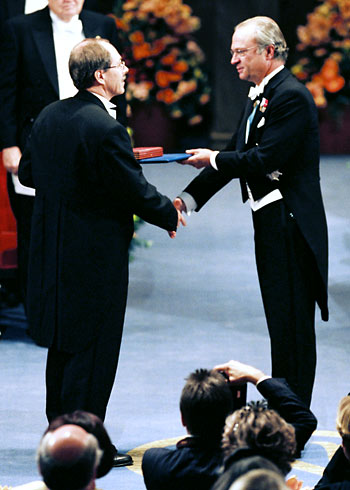
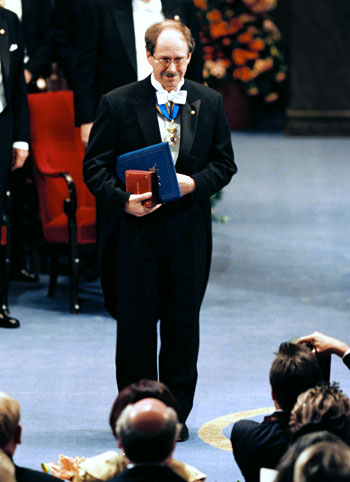
Gerardus ‘t Hooft receiving his Nobel Prize from His Majesty King Carl XVI Gustaf of Sweden at the Stockholm Concert Hall, 10 December 1999.
Copyright © The Nobel Foundation 1999, Photos: Hans Mehlin
A seemingly critical flaw in the Standard Model
By the late 1960’s, physicists were developing what would become the so-called ‘Standard Model’ of particle physics, a framework describing the fundamental particles that make up matter and the forces acting between them. While the theory showed great promise, there was a major obstacle: it was not yet clear whether some of its most important equations could produce reliable, physically meaningful predictions.
In the Standard Model, many of the interactions between elementary particles are described by so-called gauge theories, mathematical models that explain how particles interact with one another while obeying certain symmetry rules. A critical challenge was that calculations in these theories often produced infinities that seemed to make meaningful predictions impossible. At the time, many leading physicists suspected that it would be impossible to make the theory mathematically consistent at the quantum level. As a result, confidence in the theory remained limited, despite its conceptual appeal.
A breakthrough in fundamental physics
Not long after starting his PhD research under Prof. Martinus Veltman at Utrecht University, Gerard ’t Hooft found a way to approach this problem from a different angle. He realised that the apparent obstacles might be artifacts of the mathematical techniques being used, rather than fundamental flaws in the theory itself. This meant that gauge theories were in fact suitable candidates for a mathematical procedure known as renormalization, which could solve these infinities.
In his first two academic publications, both in 1971, ’t Hooft showed that this idea actually worked, applying renormalization to a class of gauge theories called Yang-Mills theories. Veltman then developed computational methods that allowed the theory’s predictions to be tested against experiments. With this method, a broad class of gauge theories could be made mathematically consistent, an important step towards eventually solidifying the Standard Model as a practical and workable theory.
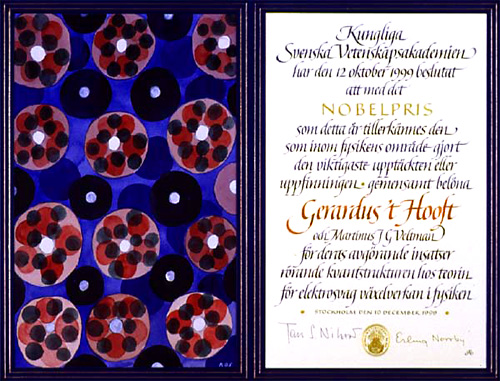
Copyright © The Nobel Foundation 1999, Artist: Nils G Stenqvist, Calligrapher: Annika Rücker
Impact on science and society
This research has had a far-reaching impact on the field of particle physics. The framework validated by ’t Hooft and Veltman became one of the cornerstones of the Standard Model of particle physics, the theory that successfully describes the known fundamental particles and most of the forces acting between them. Their work enabled generations of physicists to make increasingly precise predictions and compare them with experiments. Major advances in particle physics, including discoveries at CERN and the eventual observation of the Higgs boson, rest on theoretical foundations that include their contributions.
Beyond deepening our understanding of the universe, the broader field of particle physics has contributed to innovations in areas such as computing, data analysis, detector technology, and medical imaging, demonstrating how fundamental research can generate lasting benefits for society.